Frequently asked questions
Do heat pumps work in cold UK weather?
Yes. Modern heat pumps operate down to -25°C outside, and most still deliver full rated output at -10°C. Typical UK winters sit between 0°C and 5°C, so the unit spends most of the year well inside its comfortable range.
Efficiency does dip on the coldest days, that's normal physics, but a properly sized system is designed around peak demand at the coldest temperature your area sees. So when a real cold snap hits, the heat pump still keeps up.
How much is the Boiler Upgrade Scheme grant?
The Boiler Upgrade Scheme pays up to £7,500 toward an eligible air source heat pump in England and Wales when you replace fossil fuel or electric heating and meet the published rules. The grant comes off your total cost upfront, before any finance is applied, not as a rebate later. Eligibility depends on your property, your EPC, and your existing heating system, all of which we check during the survey before submitting the application for you.
Are heat pumps noisy?
Quieter than most people expect. Manufacturer-published sound pressure for the air-to-water models we install is typically about 25–38 dB(A) at 3 metres on everyday low load (for example Samsung Gen 7 R290 Quiet Mode in the high 20s at 3 m, and Vaillant aroTHERM plus 5 kW 36 dB(A) at 3 m on its datasheet table). Larger capacities and peak winter output sit higher; the interactive ruler on our heat pumps page uses the same published envelope.
Your install still needs an MCS noise assessment for permitted development. We run that from manufacturer data for your property before we book the work in. For how the neighbour test works, see our MCS 020 guide.
Do I need to replace my radiators?
Usually no. Heat pumps run cooler than a boiler, around 35°C to 45°C at the radiators instead of 60°C+. That means each radiator has to be big enough to heat its room at the lower temperature. Some already are. Some need swapping for a bigger panel.
In practice, most homes keep most of their radiators. A heat loss survey goes room by room and tells you exactly which ones need to change before anything gets ordered.
How long does a heat pump installation take?
Around two weeks from quote to install. The fitting itself takes 2 to 4 days on site. A straight swap where your radiators are already compatible sits at the shorter end. If you need a new hot water cylinder, larger radiators, or extra pipework, it stretches to the full four days. Your heating is off briefly during the changeover, and you'll have hot water back before the end of the day.
What size heat pump does a house need?
Domestic air source heat pumps run from 3.5 kW to 16 kW. The right size depends on how much heat your home actually loses, which comes down to floor area, insulation, glazing, and the coldest typical temperature in your area. As a rough guide, a well-insulated 3-bed semi usually lands between 6 and 10 kW.
Sizing matters. Oversize the unit and it cycles on and off, costs more, and runs inefficiently. Undersize it and it can't keep up on the coldest days. A proper heat loss survey pins the number down before anything gets ordered.
Can I keep my boiler as a backup?
Yes. A hybrid setup runs the heat pump most of the time and brings the boiler in during the coldest snaps or for quick hot water top-ups. Some heat pump models come with a hybrid kit designed for exactly this.
Most households find the boiler ends up barely firing once they get used to the heat pump. It's worth knowing the option is there if you're not ready to commit to a full switch yet, because it takes the pressure off the decision.
Do I need planning permission for a heat pump?
Usually not. Most domestic heat pump installs count as permitted development in England, Scotland and Wales, so no planning application is needed. There are conditions on the unit's size, position, and noise that vary slightly by nation, and listed buildings or conservation areas always need separate consent.
From 28 May 2026, MCS 020 is the only certification route for permitted development in England. We'll assess your specific property during the design stage and let you know what applies.
How efficient are heat pumps compared to boilers?
A gas boiler can't give you more heat than the energy in the gas it burns. About 10% gets lost up the flue, so the best it does is turn 90% of what you put in into heat.
A heat pump works the other way around. It doesn't make heat, it moves heat that's already in the outside air into your home. For every 1 unit of electricity it uses, you get back 3 to 5 units of heat. The cooler the water it sends to your radiators, the more efficient it gets, so a system running at 35°C does better than one running at 55°C. SCOP figures for any specific model can be cross-checked in the MCS Product Directory.
Properly sized installs in well-insulated homes deliver noticeable savings on running costs, and pairing the heat pump with solar panels or a smart electricity tariff stretches those savings further.
How do I know if my home is suitable for a heat pump?
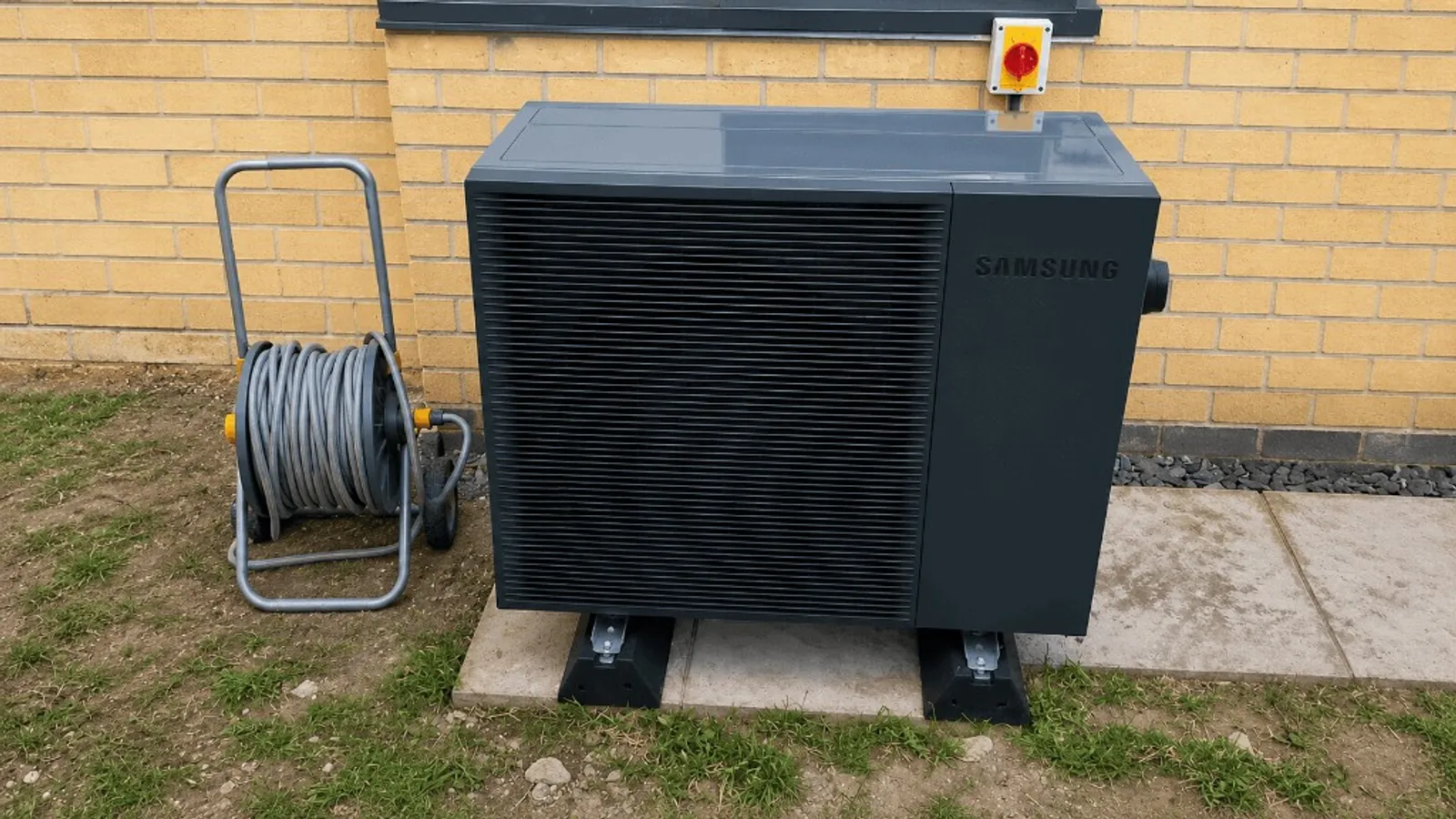
A few practical things matter. Your insulation should be reasonable, cavity walls and loft as a minimum. You need somewhere outside for the unit, roughly 1.3 m wide by 0.5 m deep. There has to be room indoors for a hot water cylinder if you don't already have one. And your radiators need to handle the lower flow temperature a heat pump runs at.
A proper survey looks at all of that and gives you a clear answer before you commit to anything.
Will my electricity bill go up after switching to a heat pump?
Your electricity bill will go up, but your overall heating bill usually goes down. The reason is efficiency: a heat pump returns 3 to 5 units of heat for every unit of electricity it draws, so the total energy you pay for is lower than running a gas or oil boiler.
The size of the saving depends on your SCOP (real-world efficiency), how well your home is insulated, and your electricity tariff. A heat-pump-friendly tariff with cheap overnight rates makes a real difference, as does pairing the system with solar. See our running costs guide for the full picture.
Can I get a heat pump on finance?
Yes. Most homeowners choose to spread the cost over several years rather than pay upfront, and finance options are available alongside the Boiler Upgrade Scheme grant. The grant comes off the headline price first, and the finance covers what's left.
Monthly payments depend on the term you pick, the amount financed, and your circumstances. We'll talk you through the options on your quote so you can compare upfront and monthly costs side by side before deciding.
Does the BUS grant cover the full cost of the install?
No, but it covers a meaningful chunk. The Boiler Upgrade Scheme pays up to £7,500 for eligible installs. A typical fully fitted system costs more than that, with the exact figure depending on your home's size, radiators, and pipework.
Your installer applies the grant directly off the price before you pay anything, so you never have to claim it back yourself.
How much can I save on running costs vs a gas boiler?
Savings typically land between 10% and 40% on annual heating costs versus a gas boiler. The variation is wide because three things drive the answer: your SCOP (real-world efficiency, usually 3.0 to 4.5), how well insulated your home is, and your electricity tariff.
Homes with good insulation, a sensible flow temperature, and a heat-pump-friendly tariff sit at the top of that range. Homes off oil or LPG usually see bigger savings again. Our running costs guide works through the numbers in detail.
How disruptive is a heat pump installation?
Less than people expect. Most installs take 2 to 4 days, with engineers working outside for the unit fitting and inside for the cylinder, pipework, and controls. Your heating is off briefly during the changeover, and hot water is usually back on the same day the boiler comes out.
There's no major building work, no rewiring of the house, and no dust beyond what comes with running new pipes through a couple of rooms. We protect floors and clear up at the end of each day.
Do I need a hot water cylinder with a heat pump?
For air-to-water heat pumps, yes. Heat pumps heat water at a lower temperature than a combi boiler does, so they store hot water in a cylinder ready for use, rather than firing on demand for each tap. Most homes use the airing cupboard for this.
If you currently have a combi boiler and no cylinder, your installer will fit one as part of the work. A 180 to 250 litre cylinder fits a typical family home. Your survey confirms the size and the best location before anything's ordered.
Will a heat pump work in a flat?
Possible, but harder than a house. The outdoor unit needs somewhere on the building it can be mounted (a balcony, an external wall, or a shared plant area), which usually means freeholder or management company consent. Leaseholders nearly always need landlord permission too.
Planning rules are stricter for flats than houses, so the noise calculation and siting get scrutinised more closely. It's worth a feasibility check early. If the building owns a communal heating system, a flat-by-flat retrofit may not be the right route, and a building-wide upgrade makes more sense.
What's the lifespan of a heat pump?
Around 15 to 20 years for a well-maintained air source heat pump, broadly similar to a gas boiler. Ground source units last longer (the ground loop itself can run 50+ years, though the indoor heat pump still needs replacing on a 20-year cycle).
The biggest factors are correct sizing, sensible flow temperatures, and a brief annual service. Run it hot all the time and you shorten its life. Run it at a steady, lower temperature and components last longer. The manufacturers we use back their products with substantial warranties.
What is SCOP and why does it matter?
SCOP stands for Seasonal Coefficient of Performance. It's the real-world average efficiency of a heat pump across a full year, accounting for cold winter days and milder shoulder seasons. A SCOP of 3.5 means the heat pump delivers 3.5 units of heat for every unit of electricity it uses.
Typical UK installs land between 3.0 and 4.5. Higher is better. Lower flow temperatures, good insulation, and correct sizing all push SCOP up. SCOP matters because it's the number that decides your running costs.
Do heat pumps need annual servicing?
Yes, an annual service is sensible, much like a boiler. The service covers a system pressure check, electrical connections, refrigerant condition, control settings, and a clean of the outdoor unit's coil and fan if there's debris on it.
It usually takes under an hour and keeps the manufacturer warranty valid. Skipping services can shorten the lifespan of the unit, especially the compressor, which is the most expensive component to replace.
Air source vs ground source: which is better?
Air source suits most UK homes. The unit sits outside, fits onto a slab next to the house, and costs less to install. Ground source is more efficient (SCOP often around 4.0 to 5.0 versus 3.0 to 4.5 for air source) because ground temperatures are more stable, but it needs land for trenches or a borehole and the install costs are significantly higher.
For a typical UK home with a garden too small for boreholes, air source wins on practicality. Ground source becomes interesting on larger plots, off-grid sites, or where running costs need to be as low as possible.
What's the difference between air-to-water and air-to-air heat pumps?
Air-to-water heat pumps heat the water that runs through your radiators and hot water cylinder, so they cover both central heating and hot water. This is what most UK homes install, and it's what the Boiler Upgrade Scheme funds.
Air-to-air heat pumps push warm air around the house through indoor units, similar to air conditioning. They heat rooms but they don't make hot water, so you still need a separate hot water source. Air-to-air units don't qualify for the BUS grant.
Can I combine the BUS grant with finance on a heat pump?
Yes, the two stack. The Boiler Upgrade Scheme grant of up to £7,500 comes off the headline install price first. Your finance agreement then covers what's left after the grant, not the full sticker price.
That means smaller monthly payments than you'd see without the grant. We confirm grant eligibility during the survey and apply it before any finance figures get quoted on your heat pump proposal.
Will applying for heat pump finance affect my credit score?
Getting an initial quote uses a soft search, which doesn't leave a mark on your credit file and isn't visible to other lenders. You can see what you'd likely be offered without any impact on your score.
When you choose to proceed with a finance agreement, the lender runs a hard search as part of the formal application. That does show on your file. See our finance page for how the soft and hard search stages work in practice.
Can I pay off my heat pump finance early?
Yes. UK consumer finance agreements give you the right to settle early at any point, and most lenders waive or reduce the remaining interest when you do. You request a settlement figure from the lender, pay it, and the agreement closes.
Some agreements include a small early settlement adjustment, which is capped under the Consumer Credit Act. The exact figure depends on the lender and how far through the term you are, but partial overpayments and full early settlement are both standard options.
Who arranges the finance for my heat pump?
Heat pump finance is arranged through FCA-authorised lenders who specialise in home improvement and renewable energy installs. We act as a credit broker, not the lender itself, and we're authorised and regulated by the Financial Conduct Authority for that role.
The lender carries out the credit assessment and holds the agreement. We handle the paperwork, the grant claim, and the install. See our finance page for the full regulatory disclosure.
Do I need a deposit for heat pump finance?
Not always. Some agreements run with no deposit at all, and others let you put down a deposit to reduce the amount financed and the monthly payment. The right choice depends on your cash position and how you want the monthly figure to land.
The BUS grant comes off the price before any deposit calculation, which lowers the amount you'd need to finance in the first place. We talk through deposit options when you receive your quote.
Last updated: