


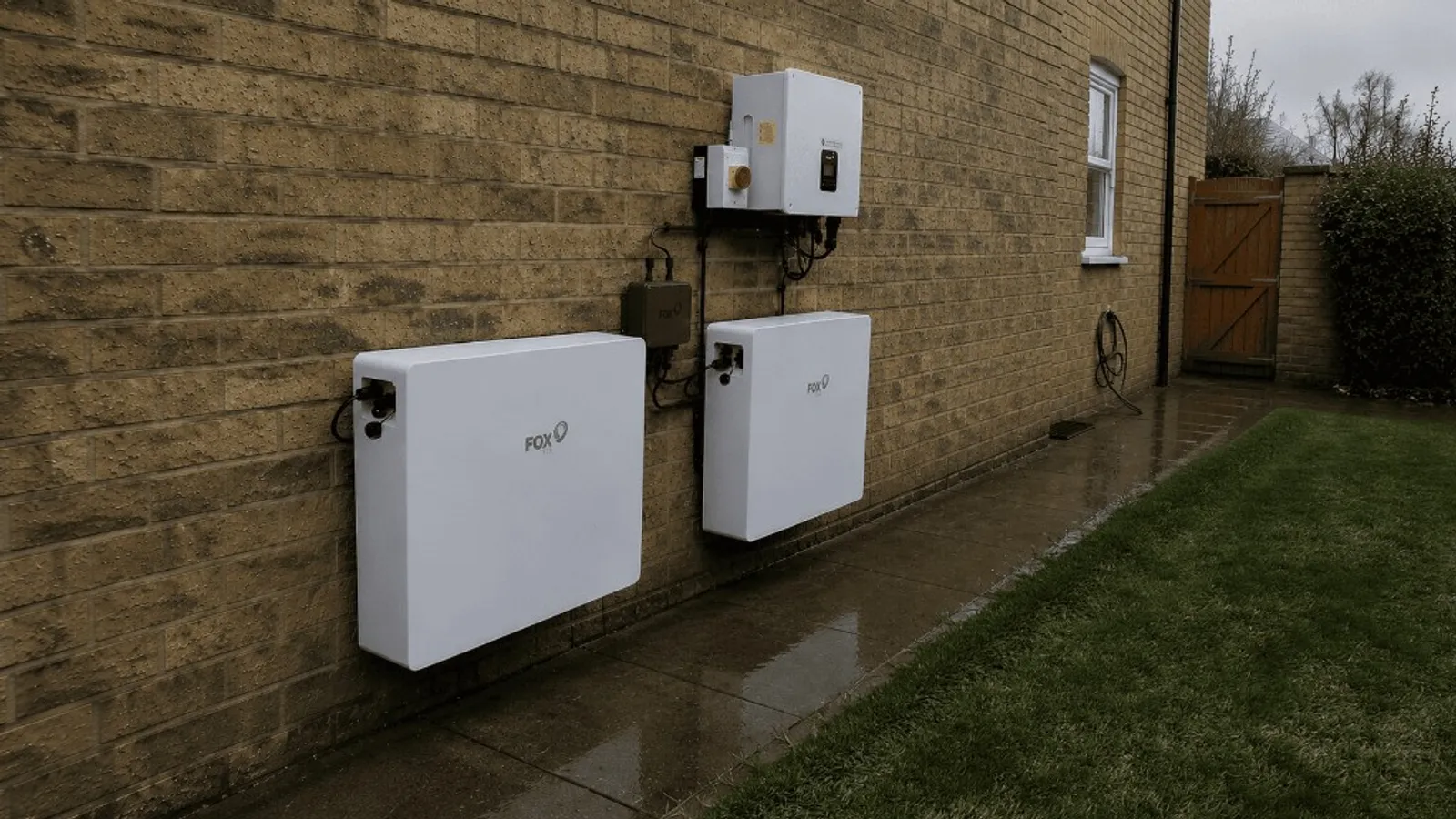
UK home battery installations climbed 130% in the first half of 2025, with almost 20,000 systems certified through MCS, according to MCS deployment data. May 2025 set a single-month record of 3,400 batteries, up 112% on May 2024. The trigger is a stack of policy and tariff changes pushing storage into the maths of a normal install: zero-rated VAT until March 2027, time-of-use tariffs that reward shifting load, and rooftop solar at 2 million UK installs.
How big the home battery market has actually got
MCS, the certification scheme for small-scale renewables in the UK, has logged 2.4 million installations across all technologies since 2009. Batteries are the fastest-growing line on that ledger, and the monthly run rate stepped up through spring 2025 (PV Magazine reporting on the MCS data).
| Period | Home batteries certified | Year-on-year change |
|---|---|---|
| H1 2024 (six-month total) | ~8,700 | Reference |
| H1 2025 (six-month total) | ~20,000 | +130% |
| May 2024 | ~1,600 | Reference |
| May 2025 | 3,400 | +112% |
The growth comes from a small base. A 10 kWh home battery, the most common UK size, holds enough to run a typical household through the evening peak and not much more. The 20,000 H1 2025 batteries add up to roughly 0.2 GWh of new residential storage.

What’s pulling the home market along
Three things sit behind the 130% jump, and they reinforce each other.
- 0% VAT on energy-saving materials. Batteries (standalone or with solar) are zero-rated until 31 March 2027 under the energy-saving materials VAT relief. After that the rate is currently set to return to 5%. On a £6,000-£9,000 installed system, that’s a meaningful saving baked in.
- Time-of-use tariffs. Cosy Octopus, Octopus Go, and EDF GoElectric split the day into cheap and expensive windows. A battery charged at 7p and discharged through a 30p evening peak earns the spread on every kWh it cycles. With solar attached, it also captures daytime export instead of selling back at a lower rate.
- Solar pairing. The UK passed 2 million solar installations in March 2026, and battery retrofits on existing arrays are a fast-growing line of installer work. Adding a battery is typically a one-day job and keeps the system MCS-registered.
Underneath all three, energy prices haven’t returned to pre-2022 levels and the import-versus-export spread stays wide, so the maths keeps working for households with significant evening use.
Grid-scale storage is a separate story
Home batteries are growing fast but residential is a small fraction of UK battery capacity overall. Grid-scale storage added 4 GWh in 2025, growth of 45% year-on-year, taking national operational capacity to 12.9 GWh (Energy-Storage.News annual review). Average project size jumped 48% to 95 MWh, the South East holds over 1.4 GWh of operational capacity, and the target for end of 2026 is 9 GW of grid-scale power.
Those are utility numbers and they shape wholesale prices, not your bill directly. They matter to the home market because as grid-scale storage smooths price volatility, time-of-use tariffs gain better data to set their cheap windows, which sharpens the case for a household battery that follows them.
What to expect from a home battery in 2026
Lithium iron phosphate (LFP) chemistry is the default for UK home installs. Cells are rated for around 6,000 charge cycles, manufacturer warranties run for 10 years, and capacity retention at the end of warranty is typically 70-80% of the original headline number. That’s enough for a decade of daily cycling without significant degradation. Hybrid inverters handling solar, battery, and grid in one unit are now standard, and retrofit kits for adding a battery to existing solar are well-established. Tesla Powerwall 3, GivEnergy, Fox ESS, and Sunsynk are the volume products.
A few things tend to trip people up. A G99 application is required for batteries above 3.68 kW per phase, and DNO approval timelines vary by region. Most home batteries don’t run your house in a power cut unless they’re paired with an Emergency Power Supply (EPS) module, and the circuits have to be wired for it at install. Tariff fit also beats raw capacity: a 10 kWh battery on a flat-rate tariff with no solar saves very little, but the same battery on Cosy Octopus alongside a 4 kWp array can save £400-£600 a year on top of the solar.
So, should you add one?
If you have solar already, you’re on a time-of-use tariff, or you’re getting solar installed and the marginal cost of adding a battery is reasonable, the maths usually works. The VAT window through March 2027 makes the next 14 months the cheapest period to install. The solar and battery storage hub covers the product side, and our is battery storage worth it guide runs through the per-household sums on import versus export rates and sizing.
If you don’t have solar, aren’t on a time-of-use tariff, and don’t have significant evening load, a standalone battery on a flat tariff is hard to justify on payback alone. Wait, or look at solar first and add a battery on retrofit later: the how many solar panels do you need guide is the starting point, and the UK energy grants for 2026 overview covers the VAT relief alongside other schemes.
The 130% growth is the easy headline. The harder takeaway is that home batteries have moved from optional accessory to default specification for a meaningful share of new solar installs, and the market is set up that way through March 2027 at least.
Frequently asked questions
Is now a good time to add a battery, or should I wait?
Will battery prices keep falling?
How does a battery work with a time-of-use tariff?
Is residential battery still small compared with grid-scale?
What size battery do most UK homes go for?
Last updated:


